
France by train: Michael's cycling trip with a folding bike through southern France
Michael's journey through southwest France with an e-folding bike and train
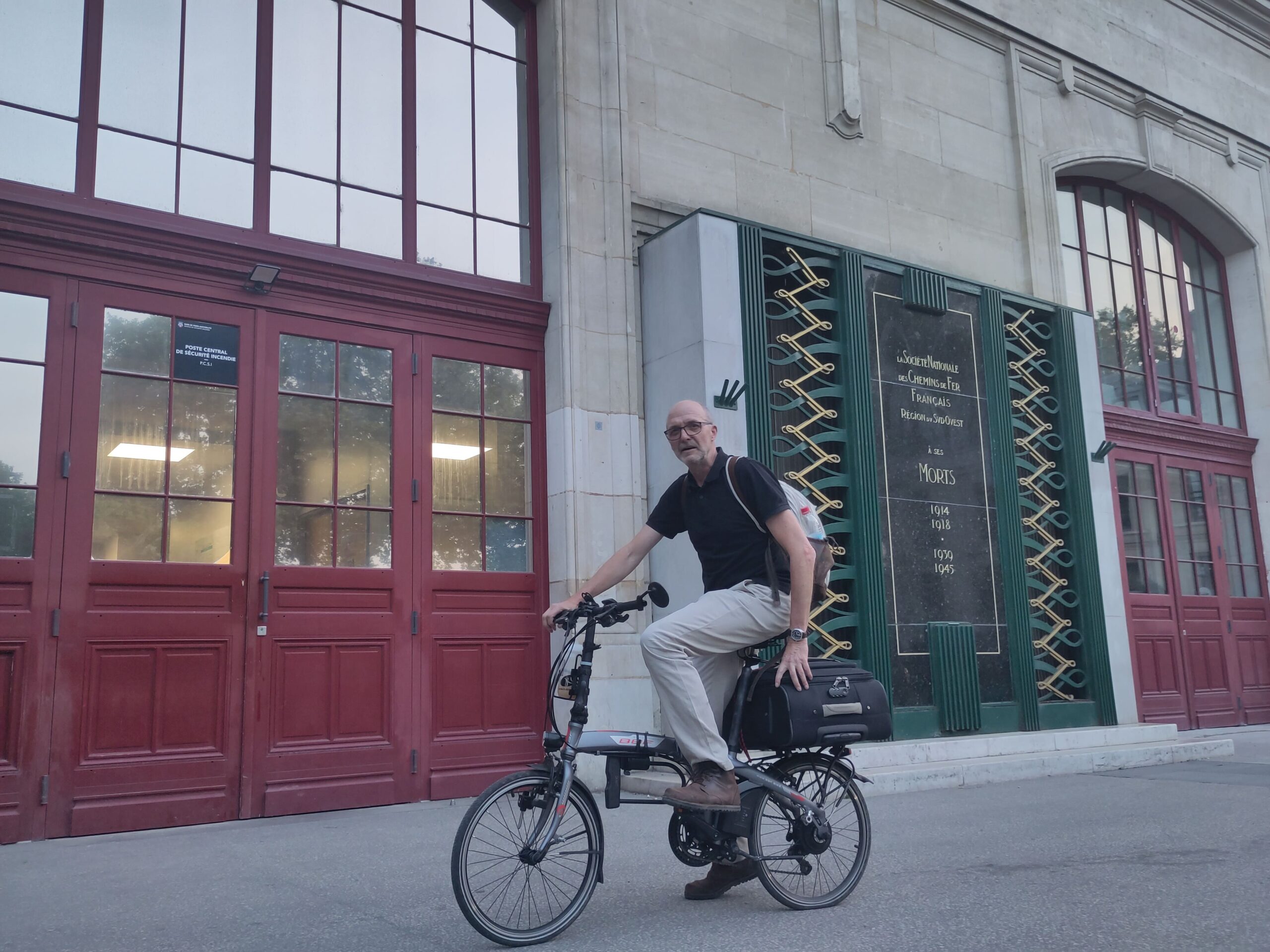
In May, Michael's first major trip of the year took him to southwestern France, more precisely to the Landes department. The region, once part of the historical Gascony, is not only home to the legendary musketeer D'Artagnan and the philosopher Montesquieu, but also a place full of cultural peculiarities: an Occitan language with Basque influences, endless forests, wide beaches, and charming villages.
Anyone who wants to cycle off the beaten tourist track, experience nature, and discover regional culture will find an inspiring combination of real-life experiences, practical tips, and a critical look at infrastructure and everyday usability in Michael's travelogue. The article is aimed at leisure cyclists, independent travelers, Francophiles, and anyone who likes to combine their tours with train rides, boat trips, or a visit to a good market – whether with or without a folding bike.
Table of contents
- Train planning: finding and booking a connection are often two different things.
- Arrival by train: From Vienna to your destination in France
- Home Exchange: Save costs with charm
- A variety of tours by bicycle and train in France: between the Atlantic, the Pyrenees and cultural sites
- Adventurous journey to the Course Landaise
- Along the dunes to Biarritz
- Cultural tour to the Romanesque villages & churches
- Natural wonder Courant d'Huchet – by bike & boat
- By train but without a bike to the Pyrenees
- Excursion to the Marais d'Orx bird sanctuary
- Across the border: Basque Country & Basque Corniche
- Return journey from France by train – insights included
- Conclusion & tips for your own trip by bike and train to and through France
Train planning: finding and booking a connection are often two different things.
The idea sounded simple: explore France by train, take your e-folding bike with you, and discover the Atlantic coast at a relaxed pace on two wheels. But finding the right train connection was anything but straightforward.
No central booking system – many platforms
Michael had hoped to simply take the ÖBB night train to Paris, as he had the previous year, and then change to a TGV. But when he tried to book in February, all the couchette berths on the ÖBB train were sold out.
So the extensive research began:
He clicked through six different platforms – Scotty, Trainline, Omio, Deutsche Bahn, SBB (Swiss Railways), Trenitalia and SNCF (French Railways) – looking for a combination of affordable, time-efficient and bicycle-friendly connections.
Particularly annoying: Some portals displayed all routes but only allowed partial bookings – usually up to the German border. Anyone wanting to travel to France had to combine tickets into several stages.
Saving tip: Carte Avantage Senior TGV INOUI
A great help to Michael in setting prices was the "Carte Avantage Senior TGV INOUI" – a discount program of the French railway (SNCF). For €49 a year, it offered numerous advantages:
- 25–30 % discount on long-distance and regional trains, also across borders
- Fixed price guarantees, e.g. a maximum of €39 for journeys under 3 hours
- Flexible cancellation policy
This card quickly pays for itself, especially for frequent travelers or those staying in France for extended periods – also for travelers from abroad.
The booked route to France by train – including prices
After hours of research, Michael booked the following route:
- Vienna – Munich:
- Travel with Westbahn for only €19.90 thanks to the climate ticket.
- → Entry into the low-floor vehicle with a folded bicycle is no problem.
- Munich – Paris (via Karlsruhe):
- By ICE train, booked via Trainline, including seat reservation: €82.14
- → With a transfer in Karlsruhe, a generous buffer and some obstacles (more on that later).
- Paris – Saint Vincent de Tyrosse:
- With the Intercités de Nuit 3731, in a 6-seater couchette: €43.00
- → The train station in Saint Vincent is only 6 km from the destination house – ideal for continuing your journey by bike.
Total costs for a one-way trip: 145,04 €
Conclusion on train planning
Without prior digital knowledge or experience with international train portals, it would hardly have been possible to reach the destination so efficiently and cheaply.
What ultimately pays off:
- Book early (ideally 2-3 months in advance)
- Generous transfer times, especially in Germany
- A certain level of frustration tolerance is required when searching for the best price.
- And: Flexibility in routing, even if the desired train is fully booked.
In the end, Michael was glad he had accepted all of that – because the trip through southern France with the folding bike was supposed to be a real highlight.
Arrival by train: From Vienna to your destination in France
Early in the morning, Michael sets off for Vienna's Westbahnhof with his folding e-bike, a medium-sized suitcase on the rack, and a backpack. The journey begins smoothly: the compact bike folds up quickly and easily fits into the low-floor carriage of the Westbahn train. In Munich, he changes to the ICE train – thanks to clever handling (saddle folded in, pedal removed), the bike fits in the luggage compartments there as well.
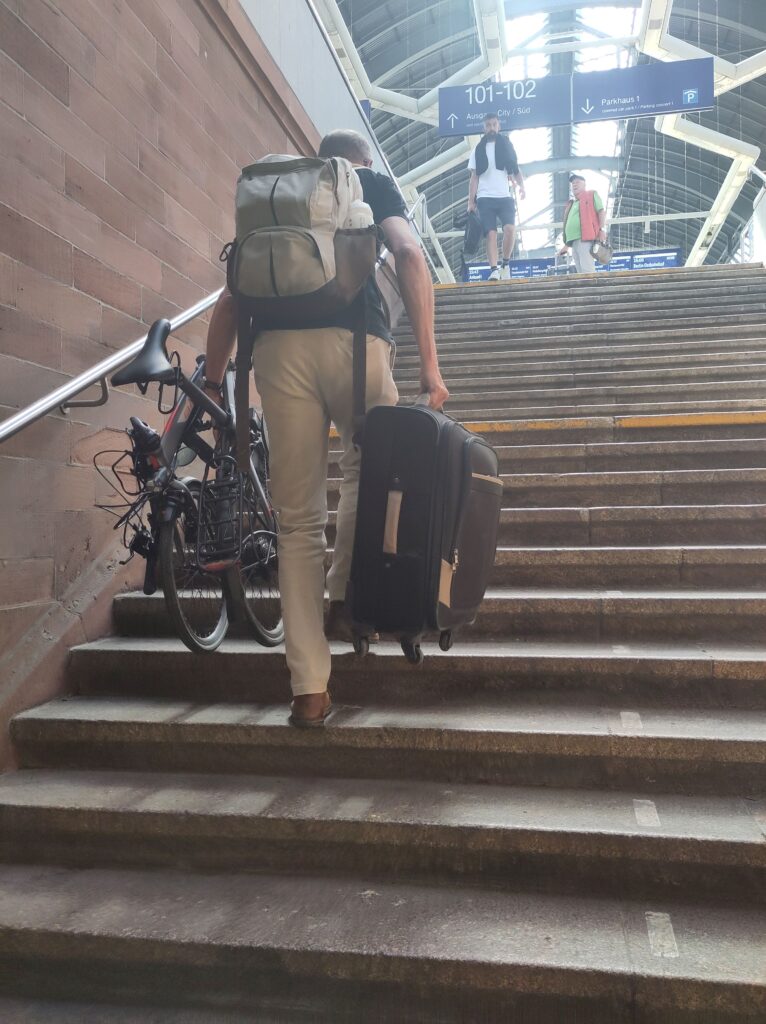
Changing platforms in Karlsruhe proves a bit of an adventure due to construction work and out-of-service elevators, but Michael finds a good grip technique to safely get his bike and suitcase down the stairs. After a short stop at the station restaurant, he continues his journey towards France.
A technical defect forces a change of train. Despite vague announcements and a platform change, Michael keeps his cool, finds a safe place for his bike, and even manages to snag a free seat in the dining car. He arrives in Paris somewhat late. The ride across the city to Austerlitz station proves challenging: narrow, bumpy bike paths and his hand on his suitcase demand attention and skill.
The next surprise awaited on the SNCF night train: the folding bike didn't fit under the bed. After a brief interlude in the aisle, a creative solution was found: an empty bed to use as a storage space. Only later did Michael discover the note on his German-language ticket: folding bikes can be taken on board free of charge. provided they are packaged and labelled. The official rule: A folding bike smaller than 130 x 90 cm is considered hand luggage.
Despite minor inconveniences, the night passes pleasantly. The compartment is equipped with a blanket, water bottle, reading light, power outlet, and Wi-Fi. Even though the restrooms open late and announcements are made exclusively in French, orientation is manageable with the help of Google Maps. Right on time at 7 a.m., Michael reaches his destination station – on the wrong side, and without an elevator. One last time, he crosses a steep bridge with his bike and luggage before the journey is almost over.
Home Exchange: Save costs with charm
After the final effort at the train station, Michael takes his folding bike a few kilometers along quiet country roads to the holiday home. The morning sun shines over the scene, the roads are empty – a gentle start to the adventure.
The house: a detached bungalow in the 1960s style, mediated via the Home Exchange platform. Michael is allowed to stay here free of charge for almost three weeks, including a fully equipped kitchen.
Homemade delicacies await as a welcome: pâté, civet de chevreuil (venison stew), and a fruity aperitif. Anyone interested in a similar travel experience should take a closer look at Home Exchange – the combination of authentic living, cultural exchange, and savings on accommodation costs makes it an exciting alternative to traditional lodging.“
A variety of tours by bicycle and train in France: between the Atlantic, the Pyrenees and cultural sites
As soon as he arrived, Michael's real adventure began: discovering southwest France on two wheels. His starting point was a bungalow near Saint Vincent de Tyrosse – ideally situated between forests, coast, rivers, and cultural gems. Sometimes he set off directly, sometimes he combined train and bike – which was always possible thanks to his folding bike.
Adventurous journey to the Course Landaise
Michael planned an afternoon drive to the traditional Course Landaise in Tercis-les-Bains. However, the 17-kilometer route proved tricky: Google Maps repeatedly led him onto impassable country lanes or dead ends. Nevertheless, he arrived in time for the event, where local performers presented daring stunts with young bulls – a bloodless bullfight.
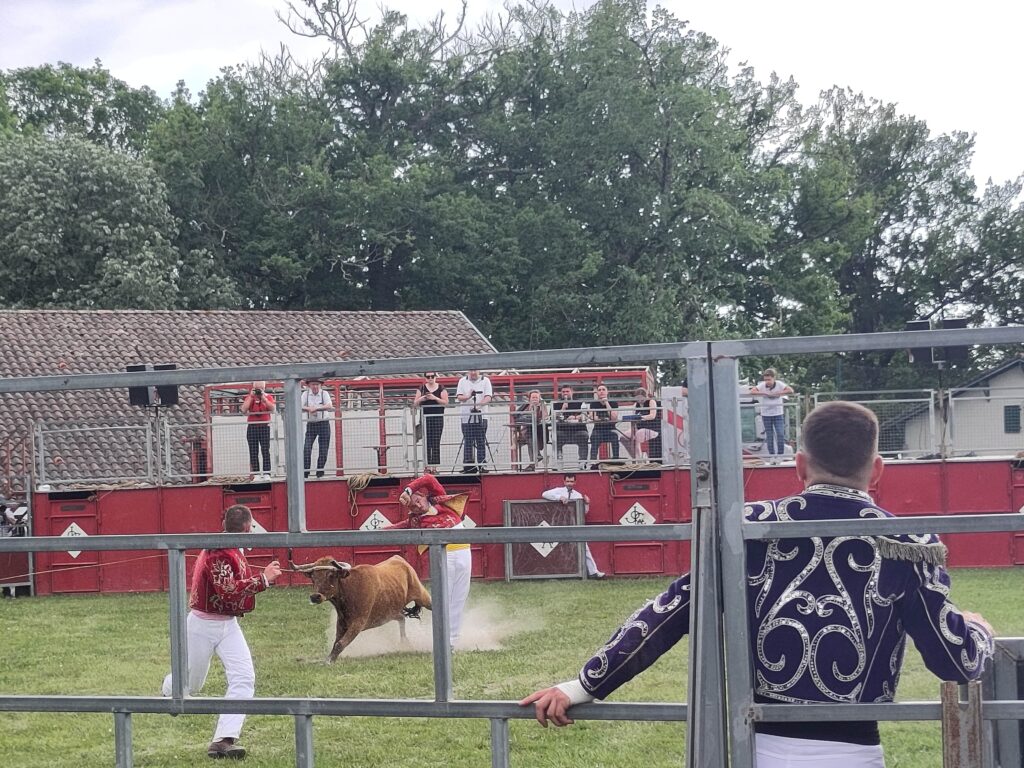
Michael describes:“The "arena" is temporary, and I'm one of very few tourists. It's impressive to see the dexterity with which the bullfighters dodge or jump over the charging bull, even with their legs tied together! Things don't always go smoothly; sometimes the bull catches the bullfighters with its horns, even though the tips are padded. Sometimes there's a fall, resulting in many bruises, and once even a bleeding backside. ”
On the return journey, he took the more scenic route along the Adour River. However, technical problems forced him to continue without e-assistance.
Tip: Don't forget to check the battery and mechanics before setting off – and when planning your route, use bicycle apps in addition to Google.
Along the dunes to Biarritz
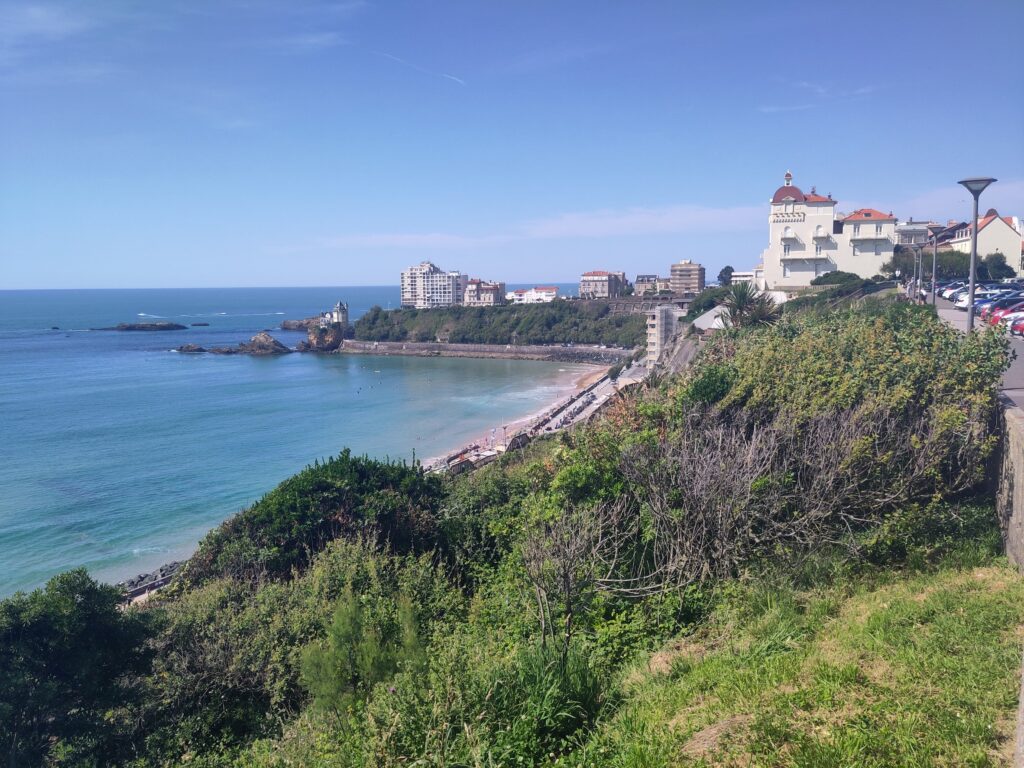
A few days later, another tour took him towards the Atlantic coast – to Biarritz, the famous seaside resort with sophisticated villas, palace hotels and surfing youths.
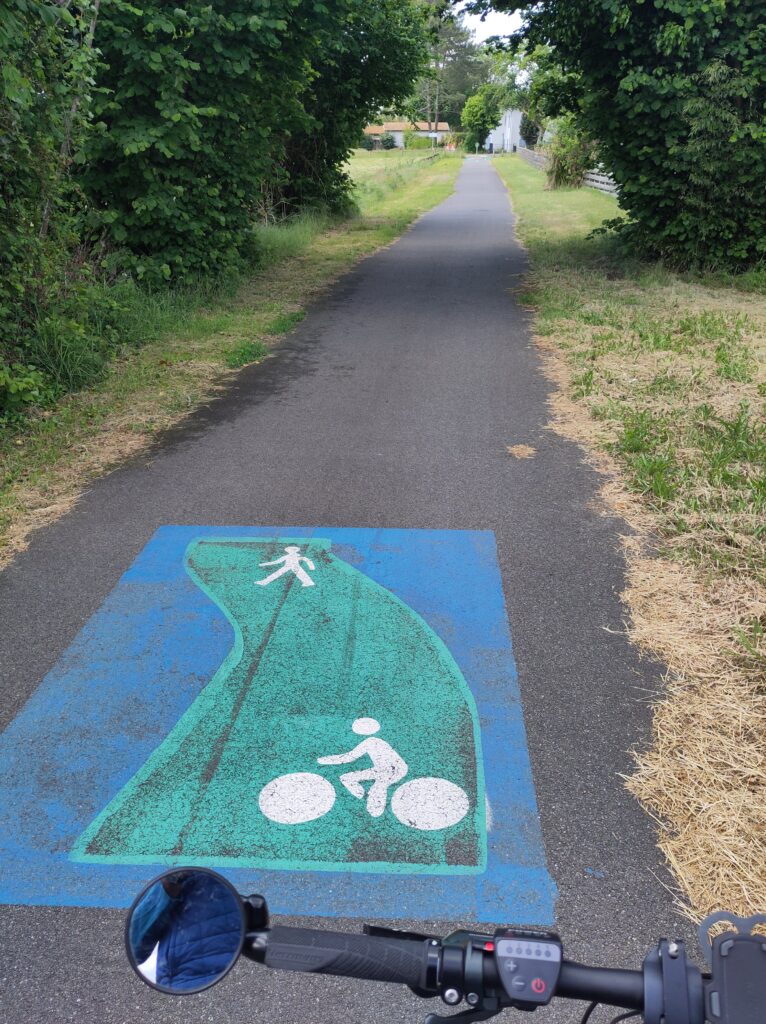
The outward journey was mostly on paved cycle paths, often hidden behind dunes. Only occasionally did he have to take uncomfortable detours – for example, at roundabouts with three sets of traffic lights. Frequent markings such as sharrows or green-on-red arrows helped with orientation.
In Biarritz itself, he cycled along the coastal promenade, admired the Art Deco architecture, and refreshed himself with a cappuccino. For the return journey, he took the train – but with a minor booking mishap: the online ticket had been accidentally booked for the wrong day, so he had to book again.
On his way home, Michael stopped at a farm shop where he bought fresh asparagus and kiwis directly from the farm – at reasonable prices.
Cultural tour to the Romanesque villages & churches
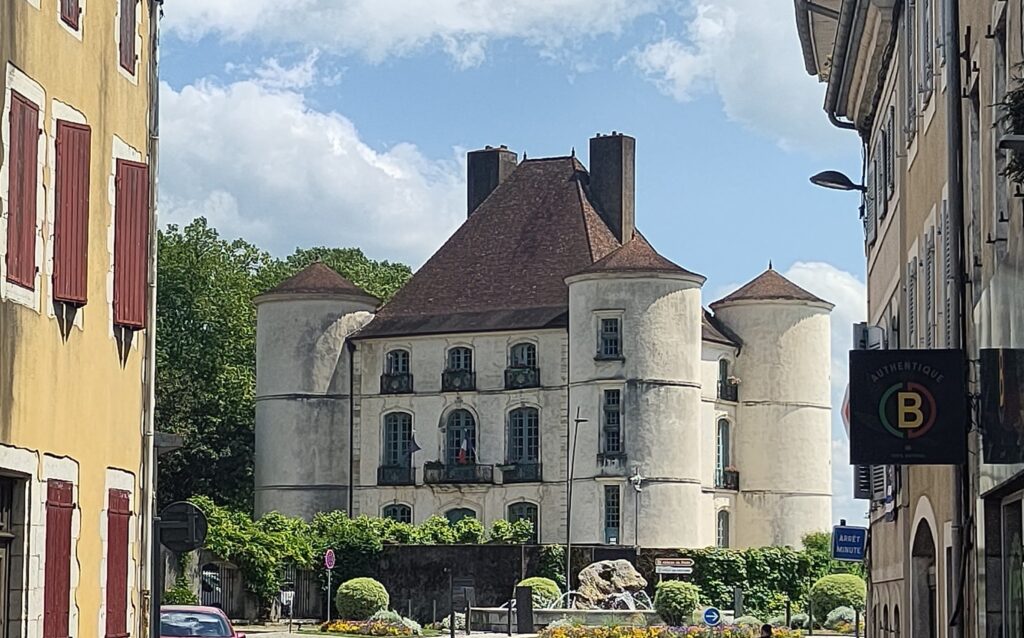
The interior of the country also offered surprises. A 57 km circular tour took him along the long-distance cycle route by the Adour River to the town of Ortheville, with its Romanesque church and beautifully renovated buildings. From there he continued to Peyrehorade, where a magnificent, picture-perfect moated castle awaited him, and then on to the well-preserved Romanesque village of Hastingues, which stretches around an abbey or bastide.
A short stop in Saint Martin de Hinx rounded off the cultural tour – there he visited another Romanesque church before heading back towards his accommodation.
Natural wonder Courant d'Huchet – by bike & boat
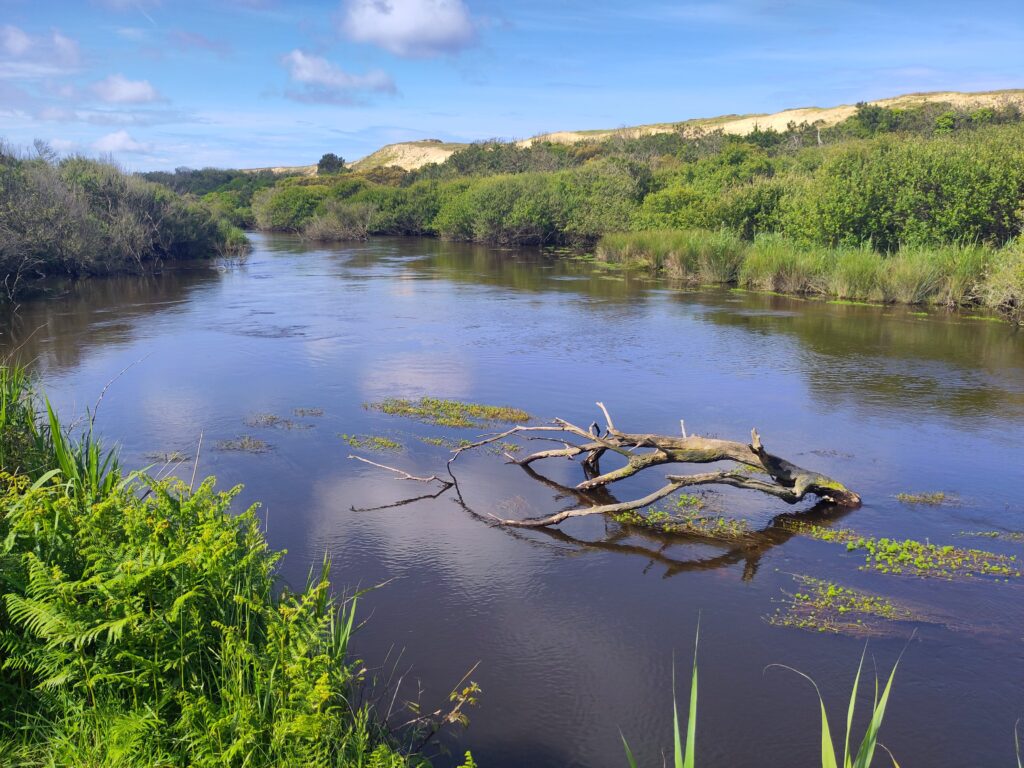
A true highlight of the trip was the day spent on the Courant d'Huchet, a protected river that flows from Lake Léon to the Atlantic Ocean. Michael set off early in the morning at 7:15 a.m. to reach the boat landing near Pichelebe, almost 45 km away, in good time. The route was virtually traffic-free, well-paved, and mostly shaded – thanks to old railway lines between Saint Vincent, Soustons, and Léon.
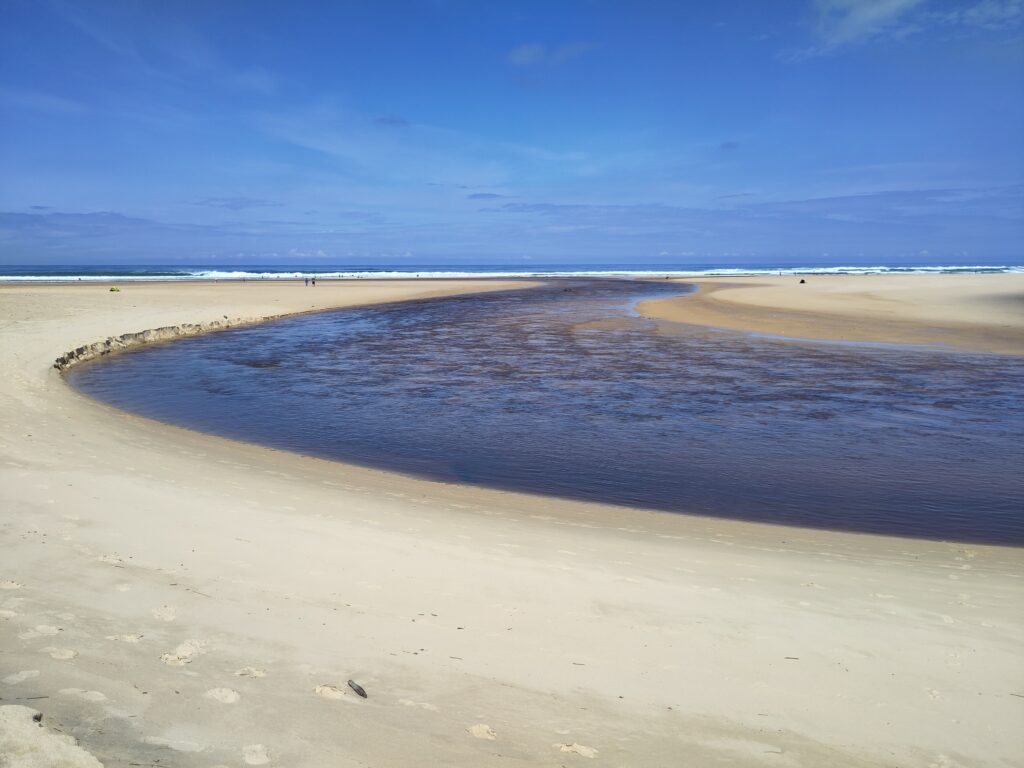
Upon arrival, a surprise awaited: the morning tour had been cancelled due to a fallen tree. Instead of getting frustrated, Michael opted for a long walk along the river – through primeval forest, cork oak groves, dunes, and reed beds to the sea. There, a large number of surfers were enjoying themselves on a vast, wide beach where the Atlantic waves were crashing. A croissant provided sustenance, followed later by Vietnamese iced coffee with condensed milk and ice cubes. (Michael thought ice cream) And a toast with lobster rounded off the waiting time.
The boat tour did eventually take place in the afternoon. Michael describes:
“First, we travel upstream towards the lake through dense, primeval forest, with giant ferns, ancient trees (including exotic species planted in the 19th century), and all sorts of wildlife. Shortly before reaching the lake, we turn around and drift downstream with the current until just before the mouth of the river (where there are small rapids to prevent lake water from entering the river). The boatman tells us a great deal about nature and history, such as how, under Napoleon (III?), the dunes were artificially raised to protect the land from storm surges. The vast lakes and surrounding marshland were drained, reclaimed, and largely reforested.„
By train to the French Pyrenees – this time without a bike
Even without a bicycle, a trip to the Pyrenees was worthwhile. On a cloudy morning, Michael set off by train and bus for Mount Le Rhune, located near the Basque coast. The weather forecast promised sunshine from early afternoon onward – reason enough for an ambitious day trip. For just €8.30, the train took him to picturesque Saint-Jean-de-Luz, where he bridged the waiting time for the bus with a stroll through the international market. Here, Basque tradition meets modern diversity – a perfect place for a first coffee.
We continued our journey by bus (round trip €2.80) up to the Col de Saint Ignacio, where the clouds slowly began to clear. Enjoying an espresso (€1.50) with a view, we noticed that English was being spoken here again without any fuss. A lovingly restored, 100-year-old cog railway leads to the summit of Le Rhune (round trip €25.50). However, upon arrival, the summit was completely shrouded in clouds, offering zero visibility. Instead of a panoramic view, we spent an hour listening to tea and a tour guide in the mountain hut at the top.
Back in the valley, there was time for another stroll through Saint-Jean-de-Luz. The town, with its bakeries, ice cream parlors, and maritime flair, has a charm all its own. Michael treated himself to an ice cream for €1.60 and bought bread at a bakery with countless baguette varieties ("integrale" here means "complete").
Excursion to the Marais d'Orx bird sanctuary
The following day, an early start took place in the Marais d'Orx bird sanctuary. The lake dates back to Napoleon's time when this area was slated for drainage for agricultural use. However, the pumping out of the water was not entirely successful, and so the area was placed under protection, as it serves as a resting place for countless birds. There, Michael participated in a guided tour where bird calls were transmitted via parabolic microphone into headphones – a perfect opportunity to hear the BirdNET app to test. Michael's test result: "In fact, all the analysis results agreed."“
Crossing the French-Spanish border by train: Basque Country & Basque Corniche
For one of his last major tours, Michael chose a cross-border route from France to Spain and back. The day began with a train ride to Hendaye (a border town with Spain), but it quickly became apparent on the platform that the French railway (SNCF) doesn't always offer intuitive navigation. There are often no displays for individual trains or their directions, neither on the platform nor on the train itself. Nevertheless, he managed to board, and Michael was able to travel to the border town with his bicycle.
From there, he cycled across the border to Irun and on to Hondarribia. There he left his bike to tackle the climb towards Jaizkibel on foot. He happened to witness a cycling race, in which first convoy vehicles and then the leading group crossed the closed road. He had enough time to reach just below the summit before turning back. The panoramic views in the sunny weather and the grazing horses on the alpine pastures nevertheless created a truly magical Pyrenean atmosphere.
Back in Irun, the traffic-calmed town center was impressive: cyclists have priority on wide streets. However, the city expressway lacked safe cycle lanes, and the EuroVelo 1 route was poorly signposted. Michael almost missed a purpose-built cycle bridge. The exit through Hendaye was also confusing and not always clearly signposted.
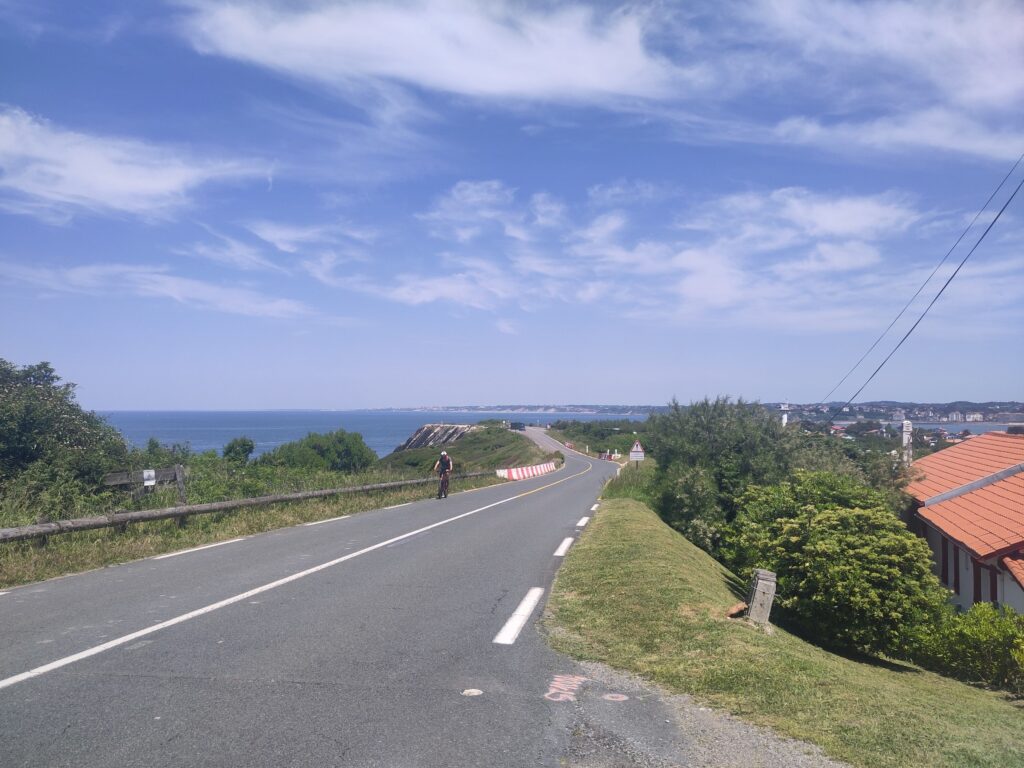
The route then led back north along the Corniche Basque. It offered spectacular views of the Atlantic, but was challenging with its constant ups and downs and some steep sections. The cycle path ended abruptly at Domaine Abbadia, and the journey continued along a busy coastal road.
The entrance to Ciboure and onward to Saint-Jean-de-Luz was once again poorly marked. In the town itself, Michael was directed onto a busy pedestrian walkway along the beach. Particularly in the northern part, there were poorly maintained, bumpy paths that ended at a confusing parking lot entrance.
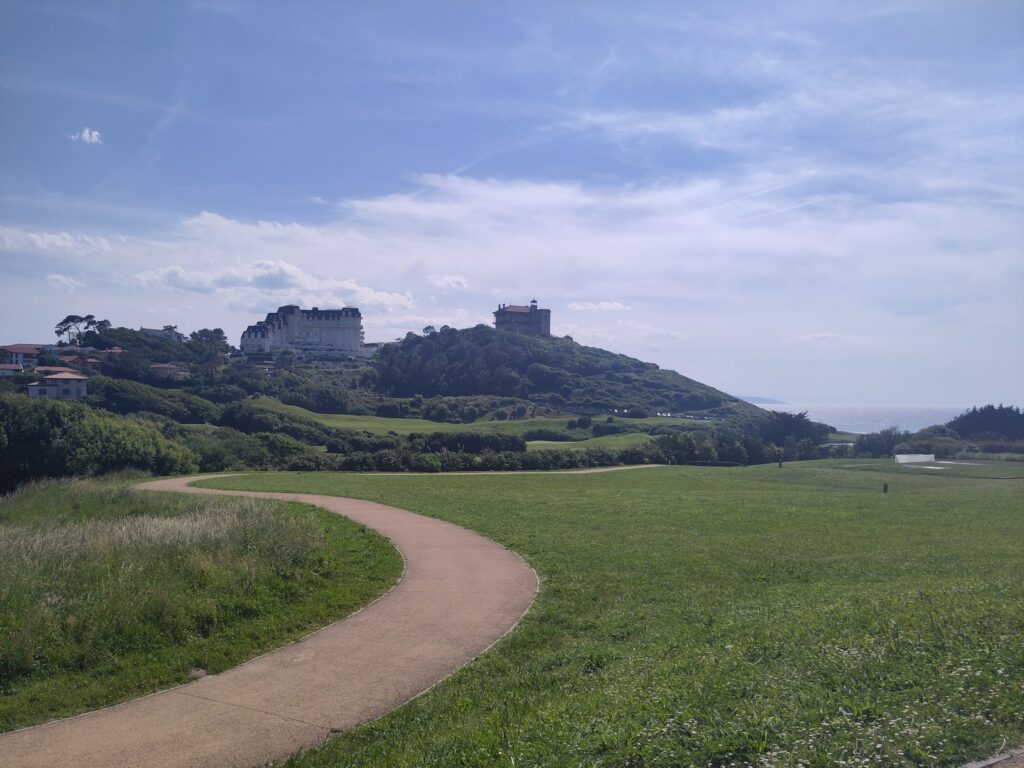
It wasn't until Guéthary and Bidart that things became more pleasant again. Michael fortified himself with a large cappuccino and a baba au rhum before continuing along the coastal promenade through elegant Biarritz and on to Bayonne. There he treated himself to a short stroll through the beautiful medieval old town before taking the train back to Saint-Vincent-de-Tyrosse.
Tip: This tour offers stunning scenery but requires good preparation, especially for navigation. Offline maps and a watchful eye on local cycle path markings are essential.
Return journey from France by train – insights included
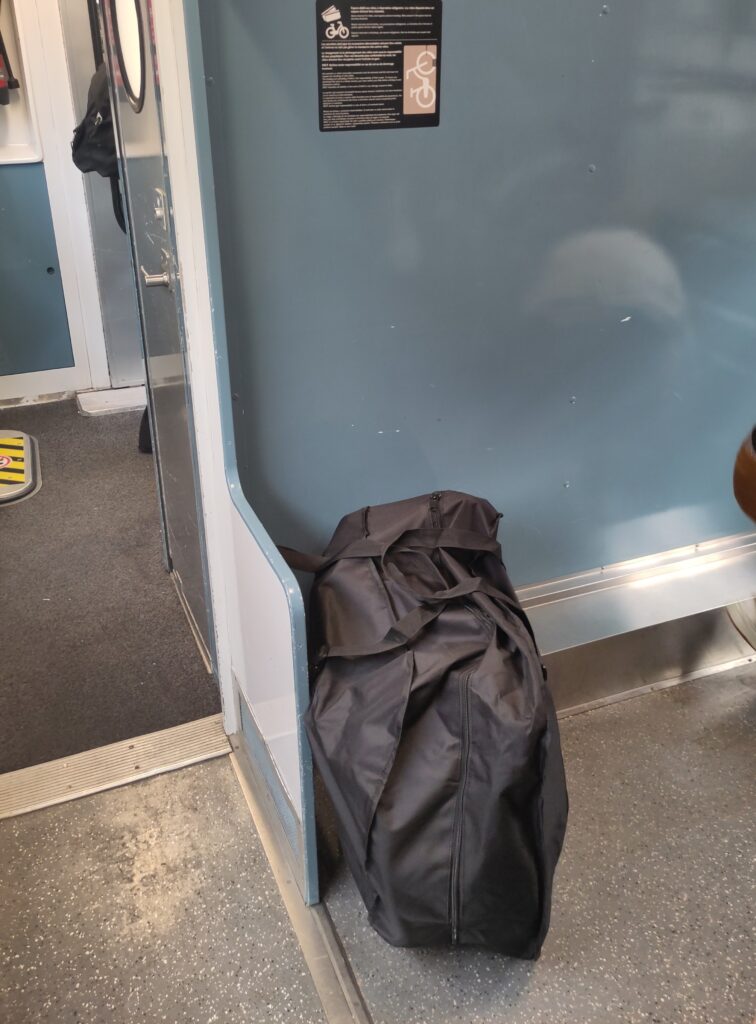
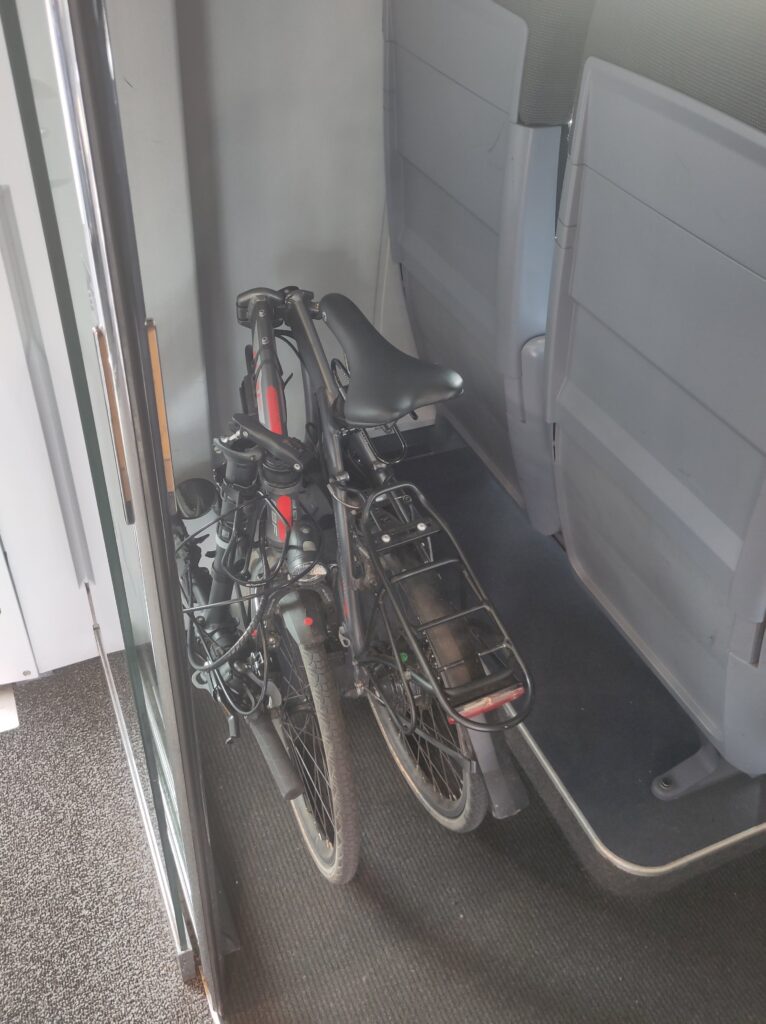
The return journey was calmer, but no less challenging: This time the folding bike was properly packed in a bag and placed in the bicycle compartment, again by night train, again with a change in Paris – and once again having to lug the bike up and down stairs.
Michael also noticed that many carriages on the Intercités de Nuit were marked with small bicycle symbols – a helpful detail he had missed on the outward journey. It would be helpful if the location of the bicycle carriages were also displayed in the app.
Conclusion & tips for your own trip by bike and train to and through France
Michael learned a lot on this trip – and anyone who wants to travel through France with a folding bike will benefit from his experiences:
Advantages of the folding bike:
- Flexibility when taking your child on the train (usually free & uncomplicated)
- Compact for city transport & accommodations
- Suitable for day trips by train and bike
- Fewer space problems on trains
- A gear system with a wider range of gears proves very useful, as it allows for good adaptation to inclines and loads.
Michael's most important tips:
- Please observe SNCF rules: Folding bicycles are considered hand luggage when folded (max. 130 × 90 cm).
- Ask train staff if it is unclear where bicycles may be stowed.
- Use cycling apps instead of Google Maps for reliable cycling routes.
- Plan in buffer times for transfers, especially in Germany.
- Secure and check the wheel well to prevent loose parts from blocking it.
- Use the SNCF app, but be patient – navigation and platform display are helpful.
- Combine travel with culinary delights: Local specialties, cultural sites and natural wonders offer unforgettable experiences.
Exploring France by train – and with a folding bike in tow – isn't always easy, but incredibly rewarding. Michael would do it again. And perhaps you'll be the next one to discover Gascony this way.
Thank you Michael for providing us with your travel report.
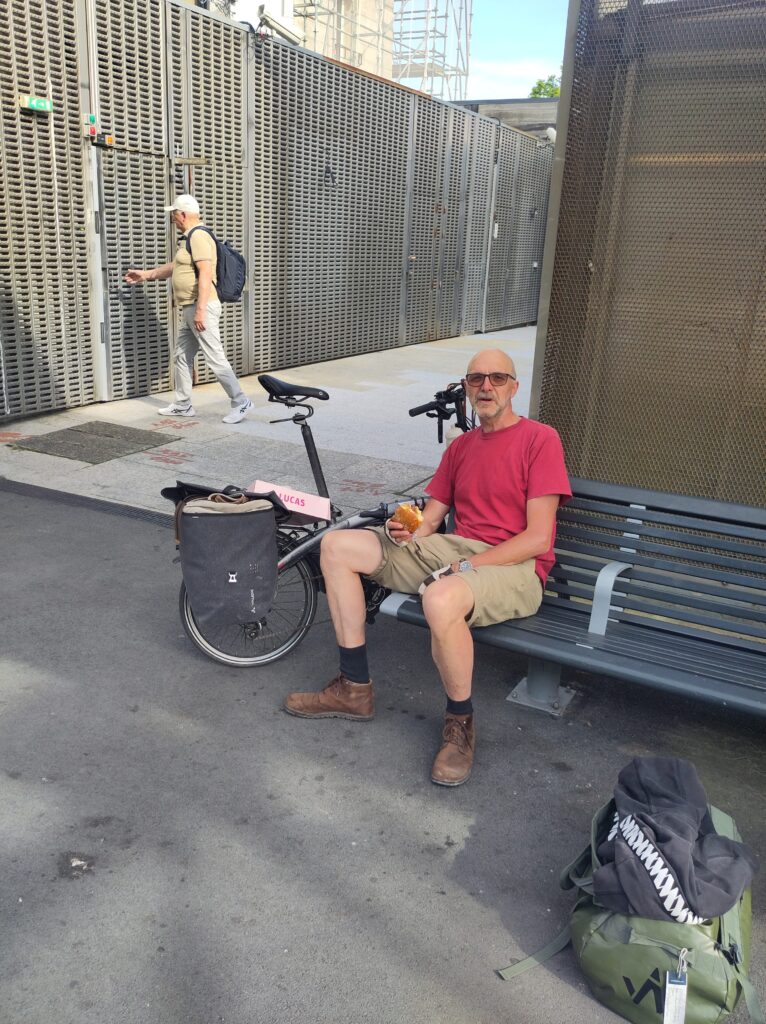
A heartfelt thank you goes to Michael Bockhorni, who provided us with his detailed travelogue, including photos, from southwestern France. His experiences, observations, and tips form the foundation of this article – we have simply edited them to present them clearly and inspiringly for our readers.
*All photos are private pictures from Michael Bockhorni, they were provided to us for this article.
Have you also experienced a special cycling trip?
Then we'd love to hear your story! Whether with family, alone, sporty or leisurely – send us your travelogue and maybe your tour will be featured in our blog series. Together, we'll inspire you to go cycling! 🚲💛
We look forward to your message.
More articles on taking your bicycle with you
-
The bicycle-on-train etiquette guide: How to successfully take your bicycle on the train
Traveling by bike on the train can often be quite chaotic. We want to use our experience to help you make your journey stress-free and enjoyable. So how can we all contribute to turning the combination of bike and train into a positive experience? Here are our top tips.
-
The advantages of the Styrian Climate Ticket
Discover the freedom of the Styrian Climate Ticket and find out how you can take your bicycle on trains for free and without restrictions. Our articles inform you about the great opportunities and regulations for exploring Styria on two wheels.
-
Taking your bicycle on the train: The perfect time
Discover the perfect time to take your bike on the train! Rush hour can be stressful, but we have all the information you need to avoid it. Find out when you should avoid your commuter train and how occupancy information can help you.